
OWN WEBSITE PROJECT · CONTENT & TECHNICAL SEO CLEANUP
A same-day review of my own portfolio website. I removed keyword-stuffed filler, rewrote misleading titles, fixed links, contact details and heading structure, and corrected a cache setting that was exposing a logged-in page version. I then checked the result with Semrush and PageSpeed Insights.
Website: mitaur.com
Date: 31 October 2026 · final crawl: 39 pages
Tools: Semrush Site Audit, Google PageSpeed Insights, WordPress, Elementor, Rank Math and LiteSpeed Cache.
THE RESULT
SITE HEALTH
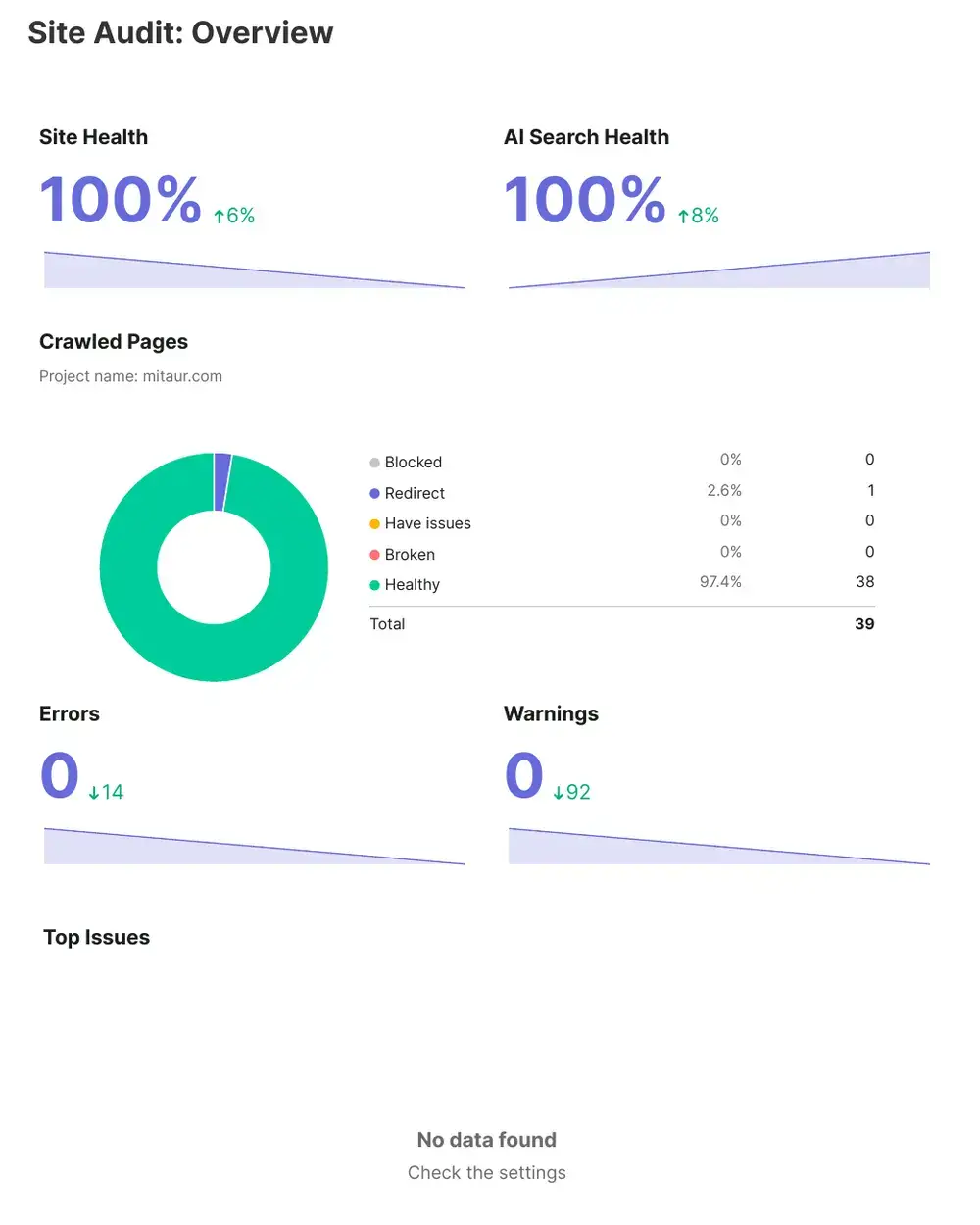
Final Semrush crawl: 38 healthy pages and 1 redirect out of 39.
ERRORS & WARNINGS
Down from 14 errors and 92 warnings in the mid-project crawl.
PAGESPEED · MOBILE
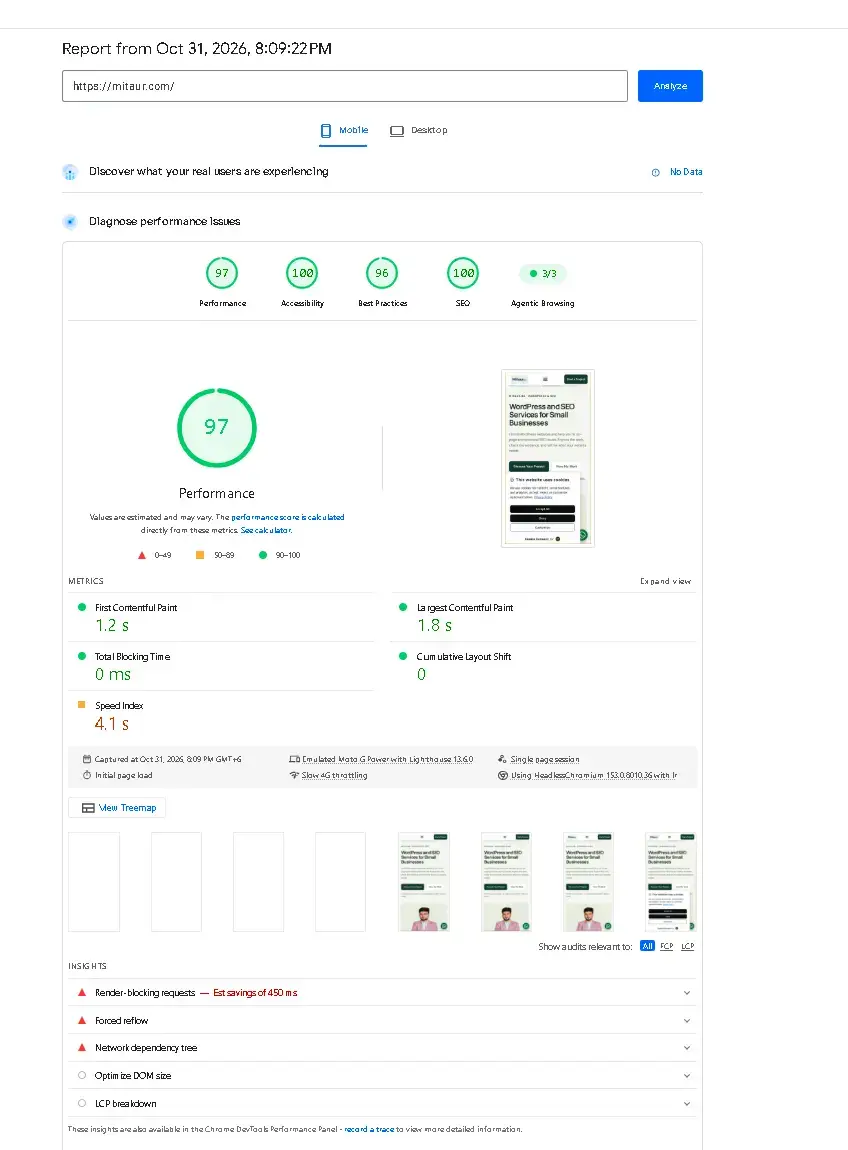
Accessibility 100, Best Practices 96 and SEO 100 in the same test.
| Metric | Mid-project crawl | Final crawl |
|---|---|---|
| Site Health | 94% | 100% |
| AI Search Health | 92% | 100% |
| Crawled pages | 45 | 39 |
| Healthy pages | 7 | 38 |
| Pages with issues | 31 | 0 |
| Broken pages | 4 | 0 |
| Blocked pages | 2 | 0 |
| Errors | 14 | 0 |
| Warnings | 92 | 0 |
PageSpeed Insights (mobile, final): Performance 97 · Accessibility 100 · Best Practices 96 · SEO 100. LCP 1.8 s, TBT 0 ms, CLS 0.
The two crawls covered a different number of pages (45 and 39), so the score change is not a like-for-like comparison. The mid-project figure also reflects a cache problem found during the work, explained in step 05.
EVIDENCE
The first image is my mid-project Semrush overview. The second is the final crawl after the fixes. Both are cropped from the original Semrush PDF exports; the figures are unchanged.
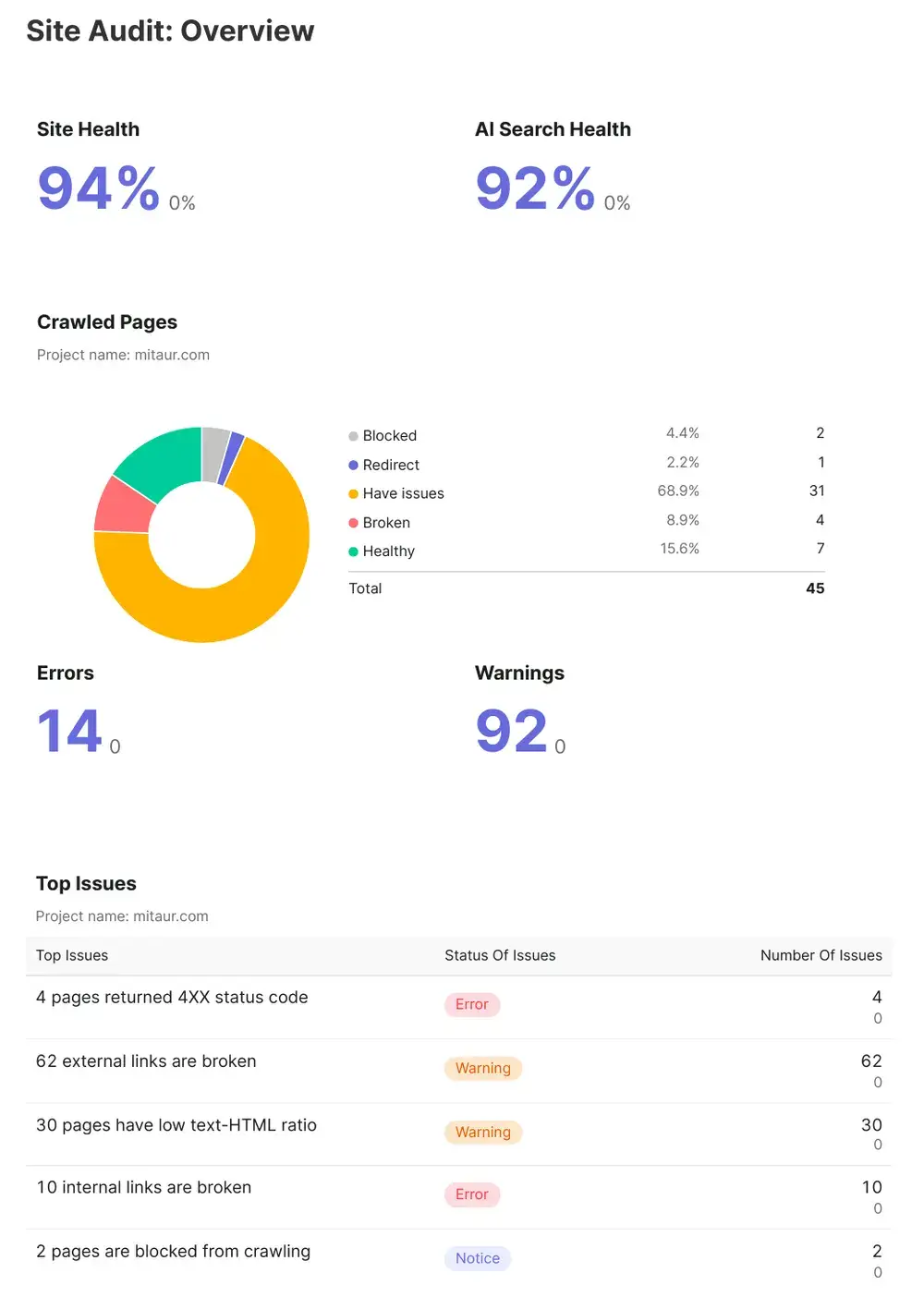
Mid-project crawl — 31 October 2026: 94% Site Health, 92% AI Search Health, 45 pages crawled, 7 healthy, 4 broken, 14 errors and 92 warnings.
Final crawl — 31 October 2026: 100% Site Health, 100% AI Search Health, 39 pages crawled, 38 healthy, 1 redirect, 0 errors and 0 warnings.
THE BRIEF
mitaur.com presents my WordPress and SEO services with evidence a visitor can check. When I reviewed it page by page, parts of the site did not meet that standard: some service pages contained repeated keyword filler written to satisfy an SEO plugin score, several titles used clickbait wording, and a few links and contact details were inconsistent.
My goal was to make every page accurate and readable first, then confirm the technical result with a fresh crawl.
STEP BY STEP
I read each Elementor page widget by widget rather than only on the front end. I found about 60 short filler sentences that repeated a focus keyword, for example 13 lines about off-page SEO placed on the on-page SEO page and 19 repeated lines on the technical SEO page. I removed them and completed a paragraph on the local SEO page that started mid-sentence.
I replaced seven SEO titles that used wording such as “7 Ways”, “10 Sizzling” or “Epic” with plain, descriptive titles; one of them named the wrong service. Three pages showed two H1 headings because the theme title appeared above the designed heading, so I hid the theme title and left a single H1 on each page.
I made the public email address consistent across 14 pages and buttons and corrected a portfolio button that pointed to the wrong website. Two internal links pointed to a default “Hello world” post; I replaced them with links to relevant guides on the site and removed two self-pingback comments.
I aligned service names, form options and FAQ capitalisation across pages, gave the social icons readable labels for screen readers, hid a third-party credit link and recoloured the skills ticker to match the site palette. I also designed a new 1200 × 630 social sharing image to replace one that showed a play-button overlay.
A Semrush crawl during the work reported 94% Site Health. Its broken-link detail showed one logout link repeated on blog posts: public visitors were being served a page version created for a logged-in administrator. I traced the cause to the “Cache Logged-in Users” setting in LiteSpeed Cache combined with the hosting CDN, turned the setting off, purged LiteSpeed and the CDN cache, and removed non-descriptive “Read more” links from the blog archive.
My final Semrush crawl reported 100% Site Health, 100% AI Search Health, 0 errors and 0 warnings across 39 pages. A mobile PageSpeed Insights test reported Performance 97, with all three Core Web Vitals lab metrics in the green range.
THE REMAINING WORK
REPORT CONTEXT
Comparison period: 31 October 2026. The mid-project crawl covered 45 pages and the final crawl 39 pages, so the two scores are not a like-for-like comparison. The mid-project score is not a baseline from before the work began; it includes the cache issue described in step 05.
An earlier, separate audit of this website on 5–6 October 2026 is documented in the first mitaur.com case study.
The figures describe what Semrush and PageSpeed Insights reported on the day. Rankings, organic traffic, enquiries and revenue were not measured.
Evidence used: two Semrush Site Audit PDF exports, the Semrush broken-link and anchor-text detail reports, a mobile PageSpeed Insights report and a record of the page edits.
YOUR WEBSITE · A CLEAR NEXT STEP
Share your website URL, the problem you want to solve and the pages that matter most. Start with an audit that records the finding, affected URL, priority, required change and verification.
Questions about this case study? Join the discussion below. Comments are reviewed before publication.