
OWN WEBSITE PROJECT · WORDPRESS SEO
A documented audit and improvement project for my portfolio website, motiurbd.com, and its blog. These before-and-after screenshots show the reported Site Health score moving from 92% to 100%, with no pages marked as having issues in the final crawl.
Project: My own website · Date: 4 October 2026
Tools: Semrush Site Audit, WordPress, Elementor, Rank Math and WPVibe.
THE RESULT
SITE HEALTH
+8 percentage points in the reported audit score.
AI SEARCH HEALTH
+1 percentage point between these two snapshots.
PAGES WITH ISSUES
No pages marked “Have issues” in the final campaign.
Healthy pages: 6 → 30 · Blocked pages: 3 → 0
Errors: 0 → 0 · Redirects: 1 → 1.
The first snapshot covers 30 crawled pages; the final snapshot covers 31. These values are transcribed from the two screenshots below.
THE EVIDENCE
Both reports are dated 4 October 2026. The original screenshots below show the source figures.
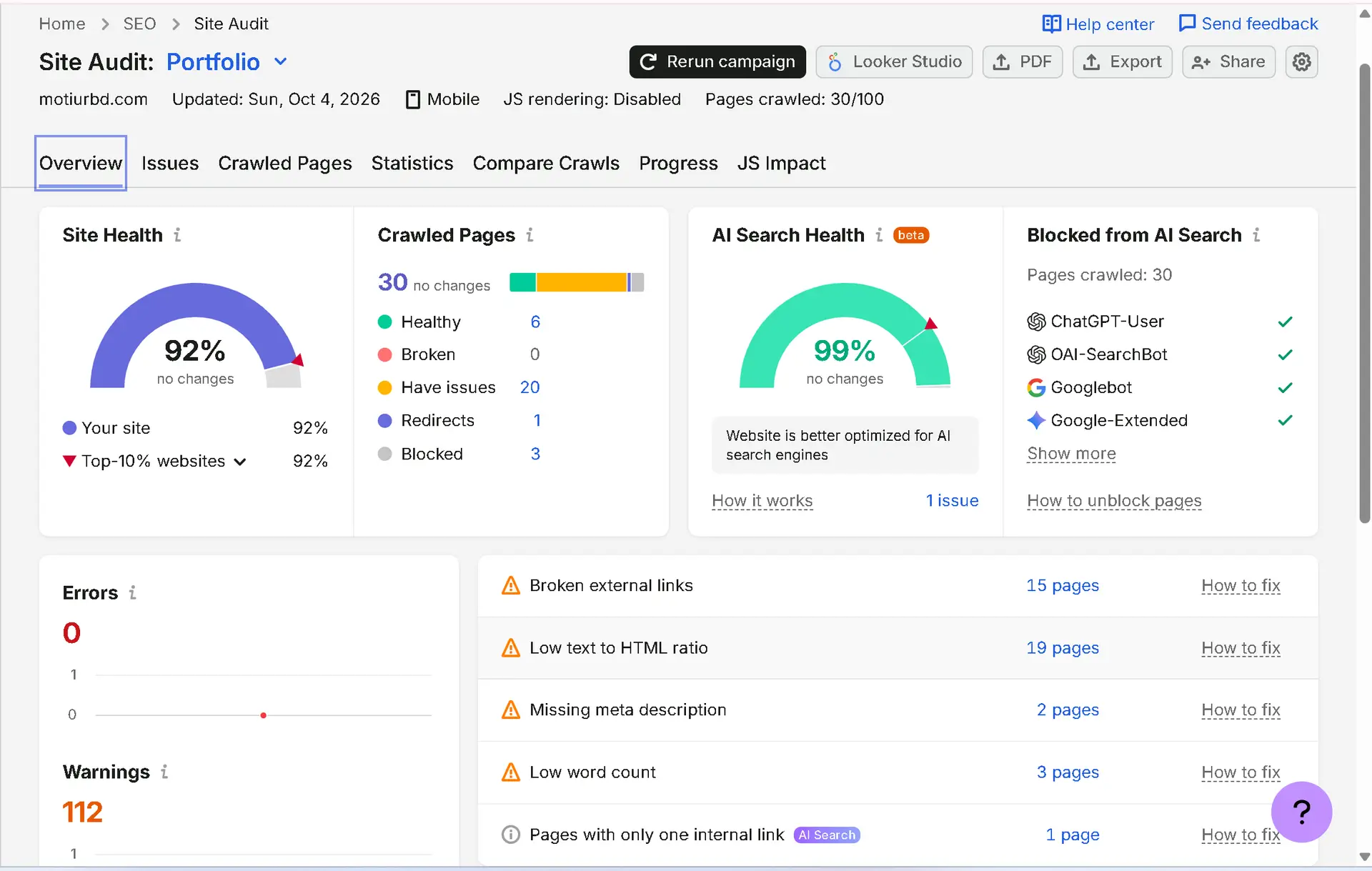
Initial snapshot: 30 pages crawled, 6 healthy, 20 with issues and 3 blocked. AI Search Health was 99%. The report showed 112 warnings and zero errors.
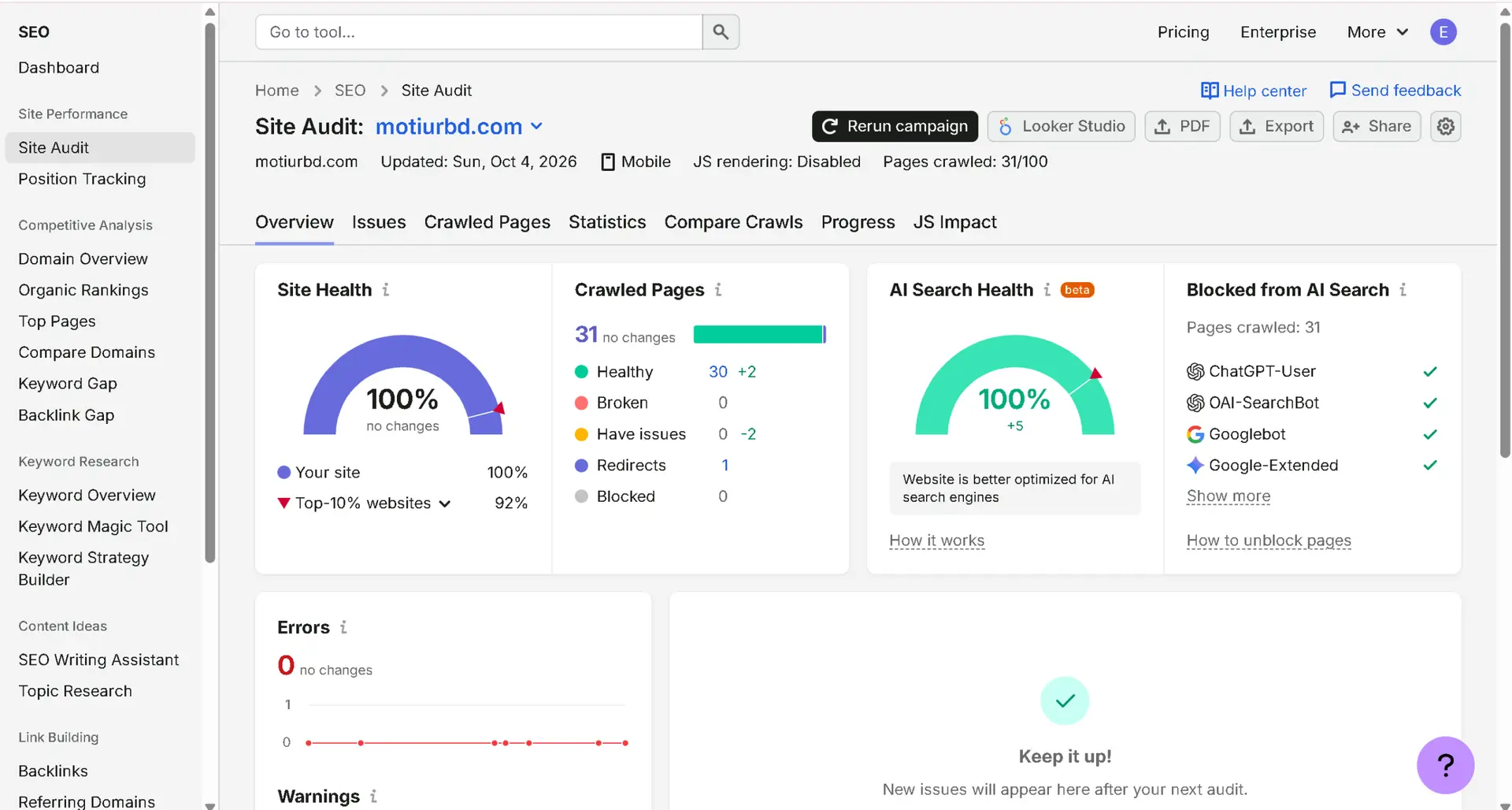
Final snapshot: 31 pages crawled, 30 healthy, zero with issues, zero blocked and one redirect. Site Health and AI Search Health both reached 100%; errors remained at zero.
THE WORK
The work covered audit review, WordPress updates and verification across motiurbd.com and blog.motiurbd.com. Changes were checked on public URLs before the campaign was run again.
Reviewed the purpose of blocked pages and enabled indexing for three public sample projects. Confirmed their sitemap inclusion, while keeping the enquiry confirmation page out of search results.
Added contextual incoming links to the blog archive and WordPress SEO checklist. Changed the six Services card headings from H3 to H2 so they follow the page H1 correctly, and corrected the blog archive card heading level.
Enabled a host-specific Strict-Transport-Security header on the main site and blog. Verified the header on live responses and checked that the relevant pages still opened successfully.
Expanded the website launch checklist with practical checks and relevant service links. Cross-linked the policy pages and removed the setting that automatically applied nofollow to every external link.
Checked rendered headings, link destinations, page responses, indexing signals and HTTPS headers. The final Semrush campaign supplied the after screenshot shown above. For the related services, see SEO audit, technical SEO and on-page SEO.
REPORT CONTEXT
This is a real project on my own website. The figures describe the selected audit campaign and its crawl scope. Rankings, search traffic, enquiries and revenue were outside this measurement.
Read the page counts alongside the scores. The initial report lists 30 crawled pages and the final report lists 31. That difference matters when comparing the number of healthy pages. Start with the named domain, date and page total in each screenshot, then read the implementation notes to see which tasks were recorded. The screenshots support the figures shown here; they do not provide a complete change history or show every request made by the crawler.
Review access and content as separate checks. Making a public sample project eligible for indexing is a different task from improving its content. A reviewer can check the page response, intended indexing signals and sitemap entry, then examine whether the explanation and links help a visitor. This project records those areas separately. It also retains the distinction between public project pages and the Thank You utility page rather than treating every URL as a page that should appear in search.
Check the work behind a shared warning. A header, footer or shared script can create the same report item on many URLs. The useful task is identifying that common source and checking its actual behaviour. The recorded third-party script exclusion belongs to the campaign context. A final score with an exclusion should be read with that note visible; the exclusion is not evidence that the external server responds successfully to every kind of request.
Keep technical verification separate from business results. This record describes indexing checks, internal links, heading order, HTTPS headers and live-page review. Those tasks can be assessed from their evidence and the published pages. To examine search traffic or enquiries, a separate review would need an agreed data source, reporting period and relevant business information. The two audit screenshots cannot supply those measurements or establish which individual task caused a ranking change.
Use the example to define your own review. If a similar issue appears on your website, provide the affected URL, the report item and what a visitor should be able to do. Preserve a baseline, record the chosen task and recheck the same area after the change. Include settings and exclusions in the handover so the next review can make a fair comparison. The value of this case study is its reviewable work record, with the score and its limits presented together.
Crawl settings: Mobile crawler, JavaScript rendering disabled. The page totals differ between the initial and final snapshots.
Recorded exclusion: One request-dependent third-party accessibility script warning was excluded after checking that the script was returned successfully when requested with the site’s referrer. This was an audit exclusion; the provider’s endpoint was not repaired or modified. The final score reflects the campaign settings and exclusions.
YOUR NEXT STEP
Share your website URL and what you want to improve. We can start with the affected pages, evidence and a practical order for the work.
Questions about this case study? Join the discussion below. Comments are reviewed before publication.